Mujoco KDL Wrapper  0.1.0
MuJoCo + KDL bridge for robot kinematics and dynamics
Loading...
Searching...
No Matches
Mujoco KDL Wrapper

A C++ library bridging MuJoCo 3.8 physics simulation with KDL for robot kinematics and dynamics.

Screenshots
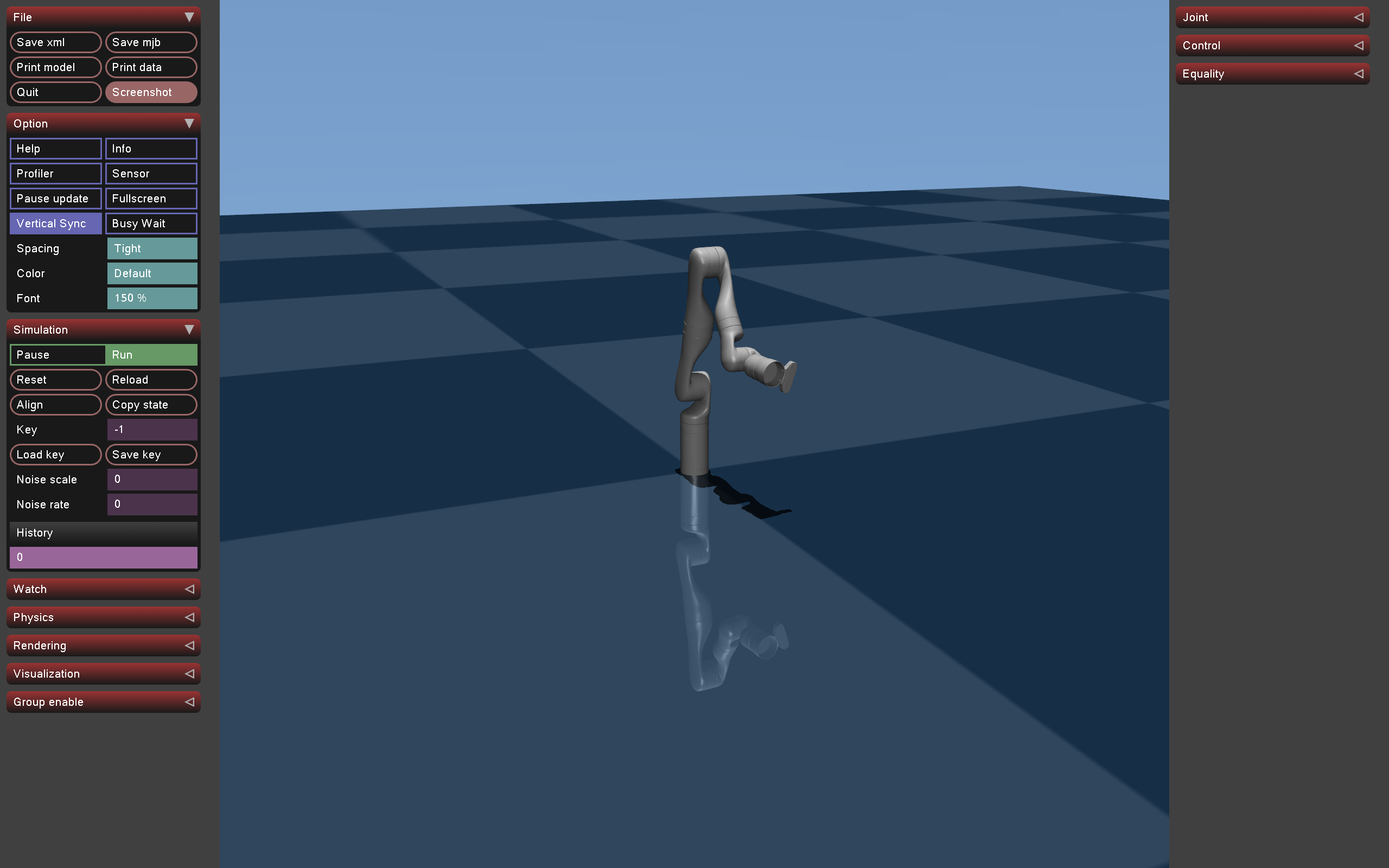

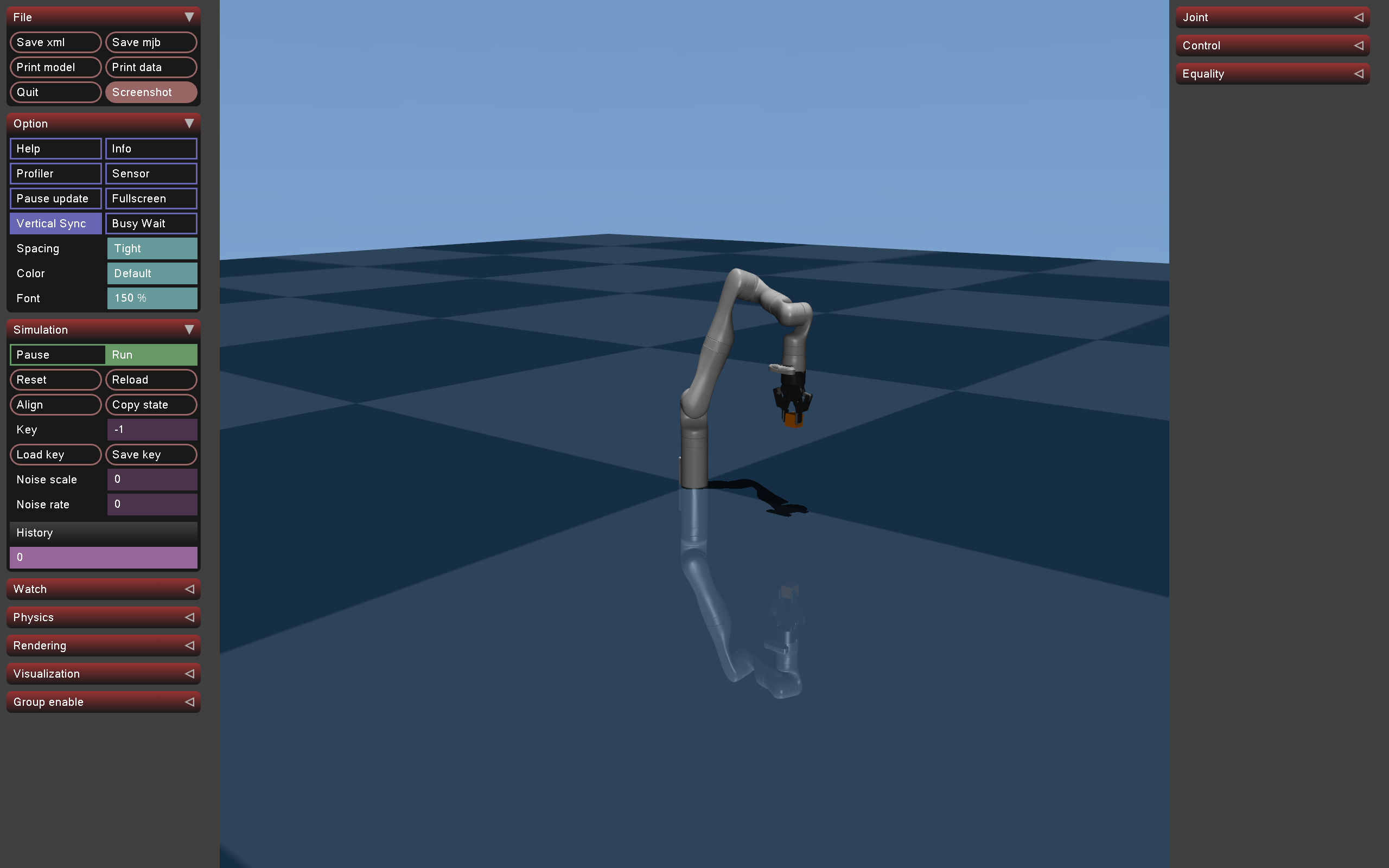
ex_gravity_comp — Single arm, KDL gravity compensation

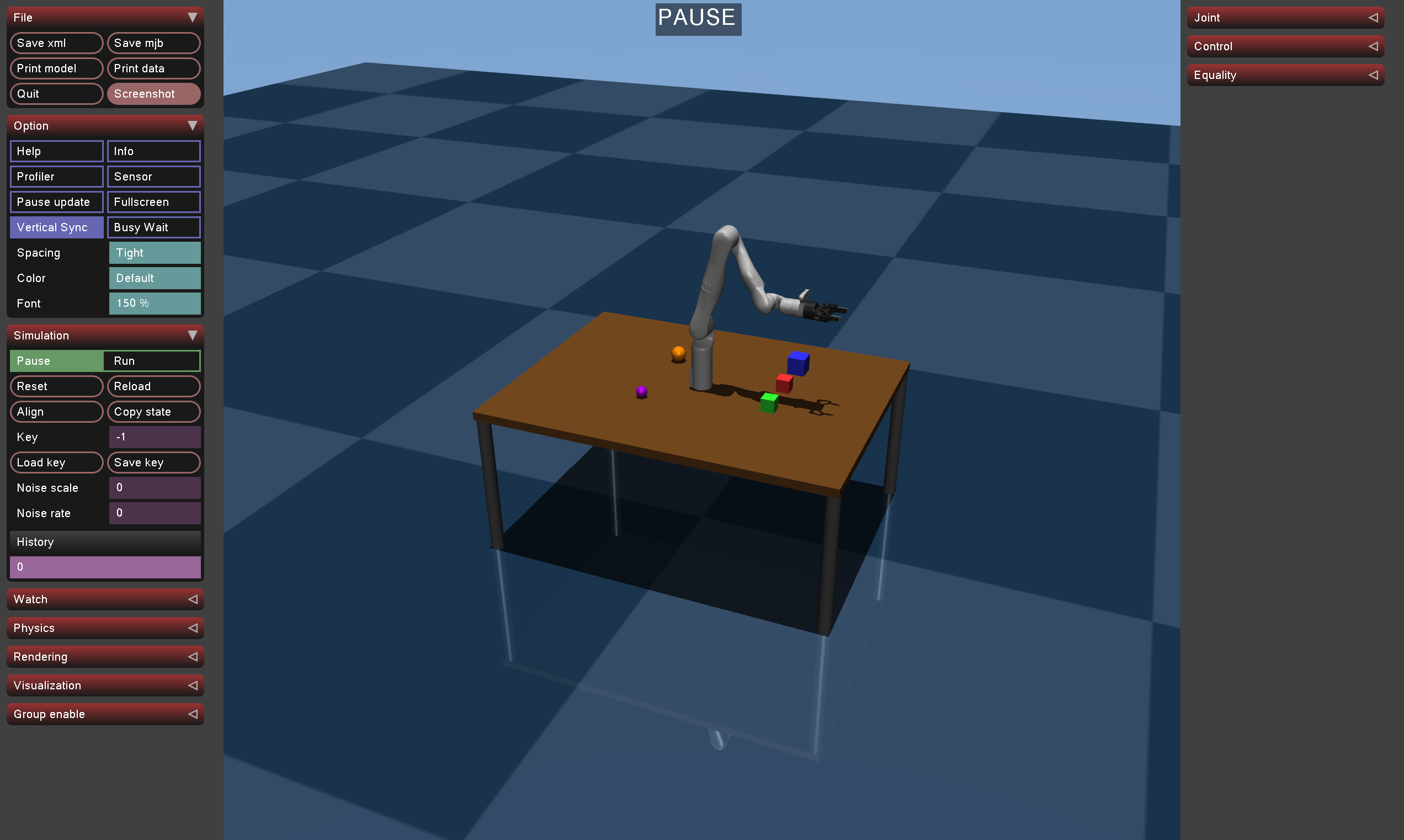
ex_table_scene — Arm + table + scene objects

ex_pick — Pick-and-place with Robotiq 2F-85

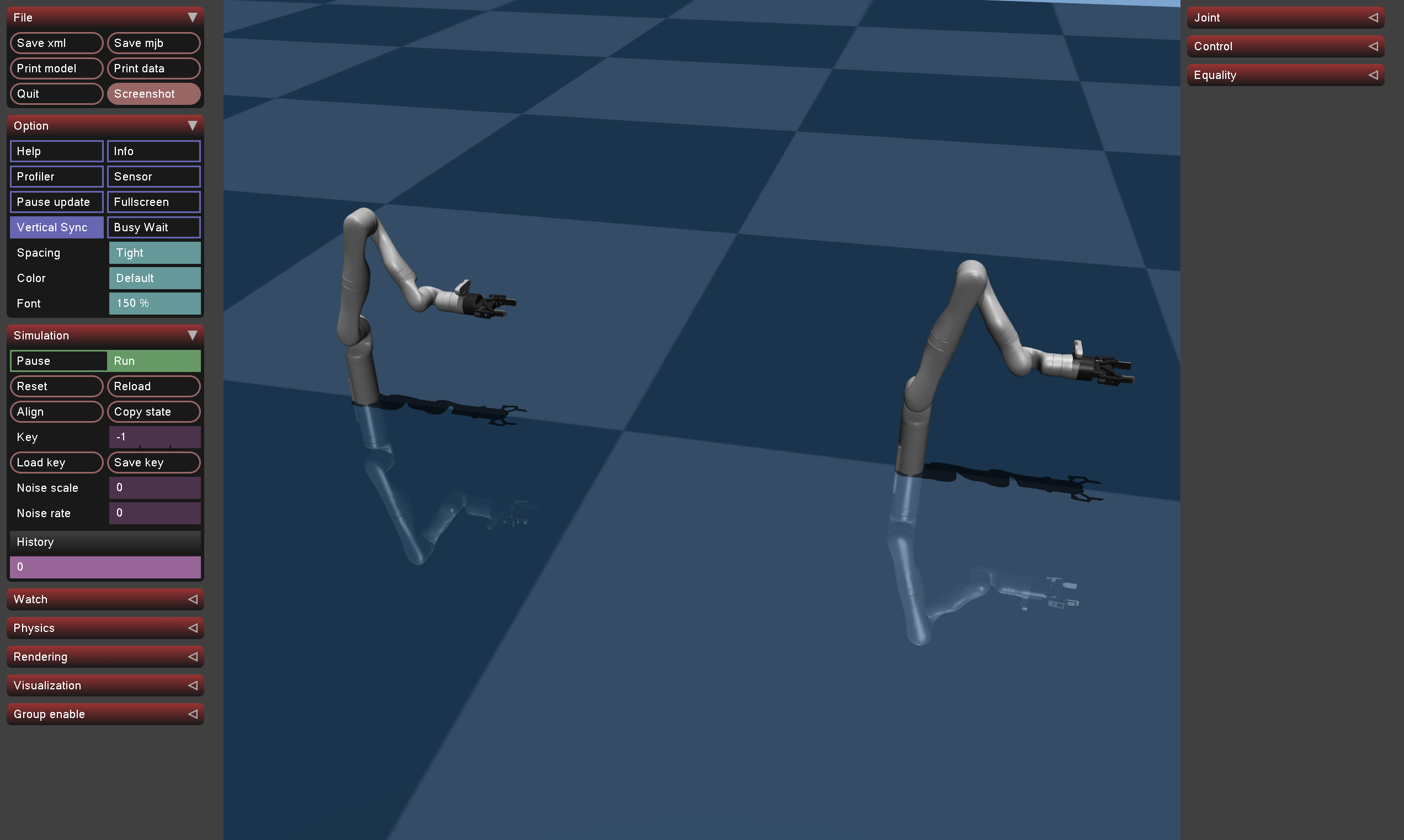
ex_dual_arm — Dual arm + grippers

Start Here

For a full step-by-step walkthrough, read docs/TUTORIAL.md. It starts from installation and gradually builds up robot control, attachments, asset-backed objects, reset hooks, cameras, the Simulate UI, recording, and multi-robot scenes.

Features

  • Unified scene builderbuild_scene() accepts MJCF files and builds floor, skybox, primitive objects, asset-backed objects, and cameras via mjSpec with no intermediate XML files
  • Ordered attachment chainsAttachmentSpec attaches any MJCF body (mount, FT sensor, gripper, arm on a mobile base) under any named body; chains of arbitrary length are applied in declaration order
  • Multi-robot scenes – place multiple robots with independent KDL chains in one shared simulation via SceneSpec::robots
  • Runtime environmentsEnv owns model/data, registered robots, and reset hooks for task-specific object/controller state
  • KDL chain from modelinit_robot_from_mjcf() builds a KDL chain directly from a compiled MuJoCo model
  • Control portsupdate() reads qpos/qvel/qfrc_actuator into *_msr and applies *_cmd in POSITION or TORQUE mode
  • Dynamics probestest/urdf_solver_probe.cpp uses the bundled Kinova GEN3 URDF to check ACHD fixed-joint outputs and compare URDF-vs-MuJoCo RNEA torques
  • Interactive viewerinit_window_sim() + step() gives your code the control loop while the MuJoCo simulate UI runs in a background render thread
  • Interactive and headless recording – Simulate UI recorder controls plus VideoRecorder for EGL offscreen MP4 recording

Dependencies

Dependency Version Install
MuJoCo 3.8.0 download to /opt/mujoco-3.8.0
GLFW 3.x sudo apt install libglfw3-dev
OpenGL / EGL sudo apt install libgl-dev libegl-dev
orocos-kdl sudo apt install liborocos-kdl-dev
ffmpeg sudo apt install ffmpeg (for VideoRecorder)

Only MuJoCo 3.8.0 is supported. CMake checks mjVERSION_HEADER and stops at configure time if MUJOCO_ROOT points to any other MuJoCo release.

orocos KDL from source (optional)

git clone https://github.com/secorolab/orocos_kinematics_dynamics.git
cd orocos_kinematics_dynamics
cmake orocos_kdl -B build_kdl \
-DCMAKE_BUILD_TYPE=Release \
-DCMAKE_INSTALL_PREFIX=~/ws/install \
-DENABLE_TESTS=OFF -DENABLE_EXAMPLES=OFF
cmake --build build_kdl -j$(nproc)
cmake --install build_kdl

Then add -DCMAKE_PREFIX_PATH=~/ws/install to the build below.

Building

wget https://github.com/google-deepmind/mujoco/releases/download/3.8.0/mujoco-3.8.0-linux-x86_64.tar.gz
tar -xzf mujoco-3.8.0-linux-x86_64.tar.gz -C /opt/
sudo apt install libglfw3-dev libgl-dev libegl-dev liborocos-kdl-dev
git clone https://github.com/secorolab/mj_kdl_wrapper.git
cd mj_kdl_wrapper
cmake -B build -DCMAKE_BUILD_TYPE=RelWithDebInfo
cmake --build build --parallel $(nproc)

Optional flags:

Flag Default Description
BUILD_RECORDER=ON ON Enable VideoRecorder (EGL + ffmpeg headless recording)
FETCH_MENAGERIE=ON OFF Download MuJoCo Menagerie robot models
BUILD_TESTS=ON ON Build and register GoogleTest tests with CTest
BUILD_DOCS=ON OFF Generate Doxygen HTML docs (cmake --build build --target docs)

The repo also carries third_party/kinova/GEN3_URDF_V12.urdf for KDL parser diagnostics. The MuJoCo model remains sourced from Menagerie.

The simulate UI screenshot button (S key) is always enabled; it uses an ffmpeg pipe to write PNGs without any third-party lodepng dependency.

The local Simulate UI also includes wrapper-specific controls in the Simulation panel:

  • RTF shows the wrapper real-time factor controlled by , and ..
  • Recorder lets you select output path, recording camera, resolution, FPS, and start/stop recording.

API

Load from MJCF

sc.robots.push_back(mj_kdl::RobotSpec{ .path = "third_party/menagerie/kinova_gen3/gen3.xml", .attachments = {} });
mjModel *model = nullptr;
mjData *data = nullptr;
mj_kdl::build_scene(&model, &data, &sc);
bool build_scene(mjModel **out_model, mjData **out_data, const SceneSpec *spec)
std::vector< RobotSpec > robots

Init KDL chain

mj_kdl::init_robot_from_mjcf(&robot, model, data, "base_link", "bracelet_link");
unsigned n = robot.n_joints; // 7 for Kinova GEN3
KDL::ChainDynParam dyn(robot.chain, KDL::Vector(0, 0, -9.81));
bool init_robot_from_mjcf(Robot *r, mjModel *model, mjData *data, const char *base_body, const char *tip_body, const char *prefix="", const ToolFrameSpec *tool=nullptr)

When a tool (gripper) is attached, pass a ToolFrameSpec so KDL dynamics include the full tool inertia and FK uses the TCP site:

const mj_kdl::ToolFrameSpec tool{ .tool_body = "g_base", .tcp_site = "g_pinch" };
mj_kdl::init_robot_from_mjcf(&robot, model, data, "base_link", "bracelet_link", "", &tool);
// ChainDynParam now accounts for arm + gripper mass.
KDL::ChainDynParam dyn(robot.chain, KDL::Vector(0, 0, -9.81));
KDL::JntArray q(n), g(n);
dyn.JntToGravity(q, g); // correct for arm + gripper

Attach a gripper (or any MJCF body)

.mjcf_path = "third_party/menagerie/robotiq_2f85/2f85.xml",
.attach_to = "bracelet_link",
.prefix = "g_",
.pos = { 0.0, 0.0, -0.061525 }, // offset along bracelet_link -Z [m]
.euler = { 180.0, 0.0, 0.0 }, // flip 180 deg around X [degrees]
.contact_exclusions = {},
};
rs.path = "third_party/menagerie/kinova_gen3/gen3.xml";
rs.attachments.push_back(gs);
sc.robots.push_back(rs);
mj_kdl::build_scene(&model, &data, &sc);
std::vector< AttachmentSpec > attachments

Chains are supported: push multiple AttachmentSpec entries in order (mount -> FT sensor -> gripper).

Multi-robot scene

sc.robots = {
mj_kdl::RobotSpec{ .path = "gen3.xml", .pos = { -0.5, 0.0, 0.0 }, .attachments = {} },
mj_kdl::RobotSpec{ .path = "gen3.xml", .prefix = "r2_", .pos = { 0.5, 0.0, 0.0 }, .attachments = {} },
};
mj_kdl::build_scene(&model, &data, &sc);
mj_kdl::Robot robot1, robot2;
mj_kdl::init_robot_from_mjcf(&robot1, model, data, "base_link", "bracelet_link");
mj_kdl::init_robot_from_mjcf(&robot2, model, data, "base_link", "bracelet_link", "r2_");

Table + objects

.name = "table",
.mjcf_path = "src/examples/assets/table.xml",
.pos = { 0.0, 0.0, 0.7 }, // asset origin is tabletop surface center
.fixed = true,
});
.path = "third_party/menagerie/kinova_gen3/gen3.xml",
.pos = { 0.0, 0.0, 0.7 },
.attachments = {},
});
.name = "red_cube",
.mjcf_path = "",
.size = { 0.03, 0.03, 0.03 },
.pos = { 0.35, 0.1, 0.73 },
.rgba = { 1.0f, 0.0f, 0.0f, 1.0f },
});
mj_kdl::build_scene(&model, &data, &sc);
std::vector< SceneObject > objects

Control loop

mj_kdl::init_window_sim(&viewer, &robot);
KDL::JntArray q(n), g(n);
while (mj_kdl::step(&robot)) { // returns false when window closes
mj_kdl::update(&robot); // read *_msr, apply *_cmd
for (unsigned i = 0; i < n; ++i) q(i) = robot.jnt_pos_msr[i];
dyn.JntToGravity(q, g);
for (unsigned i = 0; i < n; ++i) robot.jnt_trq_cmd[i] = g(i);
}
mj_kdl::cleanup(&viewer);
mj_kdl::destroy_scene(model, data);
bool step(Robot *s)
void cleanup(Robot *r)
void update(Robot *r)
void destroy_scene(mjModel *model, mjData *data)
bool init_window_sim(Viewer *v, Robot *r, const char *title="MuJoCo")
std::vector< double > jnt_pos_msr
std::vector< double > jnt_trq_cmd

Reset

reset(Env*) resets the environment runtime to its initial keyframe, calls an optional environment reset hook, re-seeds all registered robots' command ports to the current measured state, and clears stale robot forces. Use the hook to put objects, controllers, and task state back at their episode start values:

mj_kdl::init_env(&env, &scene);
mj_kdl::init_robot_from_mjcf(&robot, env.model, env.data, "base_link", "bracelet_link");
mj_kdl::env_add_robot(&env, &robot);
env.on_reset = [&](mj_kdl::ResetContext *ctx) {
// Restore robot/object/task state after mj_resetData, before mj_forward.
mj_kdl::set_joint_pos(&robot, q_home, false);
episode_step = 0;
};
opts.keyframe = 0;
mj_kdl::ResetInfo info = mj_kdl::reset(&env, &opts);
void set_joint_pos(Robot *r, const KDL::JntArray &q, bool call_forward=true)
void env_add_robot(Env *env, Robot *robot)
ResetInfo reset(Env *env, const ResetOptions *options=nullptr)
bool init_env(Env *env, const SceneSpec *spec)
ResetHook on_reset

Headless video recording

/* Requires BUILD_RECORDER=ON (default) and ffmpeg in PATH. */
/* Preset resolutions: R360p, R480p, R720p, R1080p, R2K, R4K */
/* Configure camera (optional - defaults to model-fitted free camera). */
vr.cam.azimuth = 135.0;
vr.cam.elevation = -20.0;
vr.cam.distance = 2.5;
for (int i = 0; i < 3000; ++i) {
mj_kdl::update(&robot);
// ... apply control ...
mj_kdl::step(&robot);
mj_kdl::record_frame(&vr, model, data);
}
mj_kdl::cleanup(&vr); // flushes pipe, finalises MP4
bool init_video_recorder(VideoRecorder *vr, mjModel *model, const char *out_path, int width=1280, int height=720, int fps=60)
bool record_frame(VideoRecorder *vr, mjModel *model, mjData *data)

Interactive recording is available from the Simulate UI:

  1. Open the left Simulation panel.
  2. Scroll to Recorder.
  3. Set Path, Camera, Resolution, and FPS.
  4. Press Start rec.
  5. Press Stop rec.

The recorder camera list includes Current, Free, Tracking, robot MJCF cameras, and cameras added through SceneSpec::cameras. When ffmpeg closes successfully the terminal prints:

[mj_kdl] recording saved to <filename>

Runtime add / remove objects

mj_kdl::scene_add_object(&model, &data, &sc, cube);
mj_kdl::scene_remove_object(&model, &data, &sc, "red_cube");
/* model/data are replaced; re-call init_robot_from_*() on the new pointers. */
bool scene_add_object(mjModel **model, mjData **data, SceneSpec *spec, const SceneObject &obj)
bool scene_remove_object(mjModel **model, mjData **data, SceneSpec *spec, const std::string &name)

Viewer controls

Input Action
Left drag Orbit camera
Right drag Pan camera
Scroll Zoom
Double-click body Select body for perturbation
Left drag (selected) Apply translational force
Right drag (selected) Apply torque
D Deselect body
Space Pause / resume
, Decrease wrapper real-time factor
. Increase wrapper real-time factor

All other controls (reset, quit, rendering flags, live camera selection, and recording) are in the MuJoCo panels.

More Documentation

Tests

ctest --test-dir build --output-on-failure

See test/README.md for the full list of tests.

Examples

See src/examples/README.md for the full list of examples.

Documentation

# Install Doxygen first
sudo apt install doxygen
cmake -B build -DBUILD_DOCS=ON
cmake --build build --target docs
# Open build/docs/html/index.html

Assets

Path Description
third_party/menagerie/kinova_gen3/gen3.xml Kinova GEN3 7-DOF arm (MuJoCo Menagerie)
third_party/menagerie/robotiq_2f85/2f85.xml Robotiq 2F-85 gripper (MuJoCo Menagerie)