#include <chainiksolvervel_wdls.hpp>
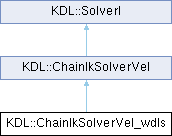
Public Member Functions | |
| ChainIkSolverVel_wdls (const Chain &chain, double eps=0.00001, int maxiter=150) | |
| ~ChainIkSolverVel_wdls () | |
| virtual int | CartToJnt (const JntArray &q_in, const Twist &v_in, JntArray &qdot_out) |
| virtual int | CartToJnt (const JntArray &, const FrameVel &, JntArrayVel &) |
| int | setWeightJS (const Eigen::MatrixXd &Mq) |
| int | setWeightTS (const Eigen::MatrixXd &Mx) |
| void | setLambda (const double lambda) |
| void | setEps (const double eps_in) |
| void | setMaxIter (const int maxiter_in) |
| unsigned int | getNrZeroSigmas () const |
| double | getSigmaMin () const |
| int | getSigma (Eigen::VectorXd &Sout) |
| double | getEps () const |
| double | getLambda () const |
| double | getLambdaScaled () const |
| int | getSVDResult () const |
| virtual const char * | strError (const int error) const |
| virtual void | updateInternalDataStructures () |
| Public Member Functions inherited from KDL::ChainIkSolverVel | |
| virtual | ~ChainIkSolverVel () |
| Public Member Functions inherited from KDL::SolverI | |
| SolverI () | |
| Initialize latest error to E_NOERROR. | |
| virtual | ~SolverI () |
| virtual int | getError () const |
| Return the latest error. | |
Static Public Attributes | |
| static const int | E_CONVERGE_PINV_SINGULAR = +100 |
| solution converged but (pseudo)inverse is singular | |
Additional Inherited Members | |
| Public Types inherited from KDL::SolverI | |
| enum | { E_DEGRADED = +1 , E_NOERROR = 0 , E_NO_CONVERGE = -1 , E_UNDEFINED = -2 , E_NOT_UP_TO_DATE = -3 , E_SIZE_MISMATCH = -4 , E_MAX_ITERATIONS_EXCEEDED = -5 , E_OUT_OF_RANGE = -6 , E_NOT_IMPLEMENTED = -7 , E_SVD_FAILED = -8 } |
| Protected Attributes inherited from KDL::SolverI | |
| int | error |
| Latest error, initialized to E_NOERROR in constructor. | |
Detailed Description
Implementation of a inverse velocity kinematics algorithm based on the weighted pseudo inverse with damped least-square to calculate the velocity transformation from Cartesian to joint space of a general KDL::Chain. It uses a svd-calculation based on householders rotations.
J# = M_q*Vb*pinv_dls(Db)*Ub'*M_x
where B = Mx*J*Mq
and B = Ub*Db*Vb' is the SVD decomposition of B
Mq and Mx represent, respectively, the joint-space and task-space weighting matrices. Please refer to the documentation of setWeightJS(const Eigen::MatrixXd& Mq) and setWeightTS(const Eigen::MatrixXd& Mx) for details on the effects of these matrices.
For more details on Weighted Pseudo Inverse, see : 1) [Ben Israel 03] A. Ben Israel & T.N.E. Greville. Generalized Inverses : Theory and Applications, second edition. Springer, 2003. ISBN 0-387-00293-6.
2) [Doty 93] K. L. Doty, C. Melchiorri & C. Boniveto. A theory of generalized inverses applied to Robotics. The International Journal of Robotics Research, vol. 12, no. 1, pages 1-19, february 1993.
Constructor & Destructor Documentation
◆ ChainIkSolverVel_wdls()
|
explicit |
Constructor of the solver
- Parameters
-
chain the chain to calculate the inverse velocity kinematics for eps if a singular value is below this value, its inverse is set to zero, default: 0.00001 maxiter maximum iterations for the svd calculation, default: 150
◆ ~ChainIkSolverVel_wdls()
| KDL::ChainIkSolverVel_wdls::~ChainIkSolverVel_wdls | ( | ) |
Member Function Documentation
◆ CartToJnt() [1/2]
|
inlinevirtual |
not (yet) implemented.
Implements KDL::ChainIkSolverVel.
◆ CartToJnt() [2/2]
|
virtual |
Find an output joint velocity qdot_out, given a starting joint pose q_init and a desired cartesian velocity v_in
- Returns
- E_NOERROR=svd solution converged in maxiter E_SVD_FAILED=svd solution failed E_CONVERGE_PINV_SINGULAR=svd solution converged but (pseudo)inverse singular
- Note
- if E_CONVERGE_PINV_SINGULAR returned then converged and can continue motion, but have degraded solution
- If E_SVD_FAILED returned, then getSvdResult() returns the error code from the SVD algorithm.
Implements KDL::ChainIkSolverVel.
◆ getEps()
|
inline |
Request the value of eps
◆ getLambda()
|
inline |
Request the value of lambda for the minimum
◆ getLambdaScaled()
|
inline |
Request the scaled value of lambda for the minimum singular value 1-6
◆ getNrZeroSigmas()
|
inline |
Request the number of singular values of the jacobian that are < eps; if the number of near zero singular values is > jac.col()-jac.row(), then the jacobian pseudoinverse is singular
◆ getSigma()
| int KDL::ChainIkSolverVel_wdls::getSigma | ( | Eigen::VectorXd & | Sout | ) |
Request the six singular values of the Jacobian
◆ getSigmaMin()
|
inline |
Request the minimum of the first six singular values
◆ getSVDResult()
|
inline |
Retrieve the latest return code from the SVD algorithm
- Returns
- 0 if CartToJnt() not yet called, otherwise latest SVD result code.
◆ setEps()
| void KDL::ChainIkSolverVel_wdls::setEps | ( | const double | eps_in | ) |
Set eps
◆ setLambda()
| void KDL::ChainIkSolverVel_wdls::setLambda | ( | const double | lambda | ) |
Set lambda
◆ setMaxIter()
| void KDL::ChainIkSolverVel_wdls::setMaxIter | ( | const int | maxiter_in | ) |
Set maxIter
◆ setWeightJS()
| int KDL::ChainIkSolverVel_wdls::setWeightJS | ( | const Eigen::MatrixXd & | Mq | ) |
Set the joint space weighting matrix
- Parameters
-
weight_js joint space weighting symmetric matrix, default : identity. M_q : This matrix being used as a weight for the norm of the joint space speed it HAS TO BE symmetric and positive definite. We can actually deal with matrices containing a symmetric and positive definite block and 0s otherwise. Taking a diagonal matrix as an example, a 0 on the diagonal means that the corresponding joints will not contribute to the motion of the system. On the other hand, the bigger the value, the most the corresponding joint will contribute to the overall motion. The obtained solution q_dot will actually minimize the weighted norm sqrt(q_dot'*(M_q^-2)*q_dot). In the special case we deal with, it does not make sense to invert M_q but what is important is the physical meaning of all this : a joint that has a zero weight in M_q will not contribute to the motion of the system and this is equivalent to saying that it gets an infinite weight in the norm computation. For more detailed explanation : vince.nosp@m.nt.p.nosp@m.adois.nosp@m.@upm.nosp@m.c.fr
- Returns
- success/error code
◆ setWeightTS()
| int KDL::ChainIkSolverVel_wdls::setWeightTS | ( | const Eigen::MatrixXd & | Mx | ) |
Set the task space weighting matrix
- Parameters
-
weight_ts task space weighting symmetric matrix, default: identity M_x : This matrix being used as a weight for the norm of the error (in terms of task space speed) it HAS TO BE symmetric and positive definite. We can actually deal with matrices containing a symmetric and positive definite block and 0s otherwise. Taking a diagonal matrix as an example, a 0 on the diagonal means that the corresponding task coordinate will not be taken into account (ie the corresponding error can be really big). If the rank of the jacobian is equal to the number of task space coordinates which do not have a 0 weight in M_x, the weighting will actually not impact the results (ie there is an exact solution to the velocity inverse kinematics problem). In cases without an exact solution, the bigger the value, the most the corresponding task coordinate will be taken into account (ie the more the corresponding error will be reduced). The obtained solution will minimize the weighted norm sqrt(|x_dot-Jq_dot|'(M_x^2)|x_dot-Jq_dot|). For more detailed explanation : vince.nosp@m.nt.p.nosp@m.adois.nosp@m.@upm.nosp@m.c.fr
- Returns
- success/error code
◆ strError()
|
virtual |
Return a description of the latest error
- Returns
- if error is known then a description of error, otherwise "UNKNOWN ERROR"
Reimplemented from KDL::SolverI.
◆ updateInternalDataStructures()
|
virtual |
Update the internal data structures. This is required if the number of segments or number of joints of a chain/tree have changed. This provides a single point of contact for solver memory allocations.
Implements KDL::ChainIkSolverVel.
Member Data Documentation
◆ E_CONVERGE_PINV_SINGULAR
|
static |
solution converged but (pseudo)inverse is singular
The documentation for this class was generated from the following file:
- build/orocos_kdl_install/include/kdl/chainiksolvervel_wdls.hpp
Generated by
 1.16.1